

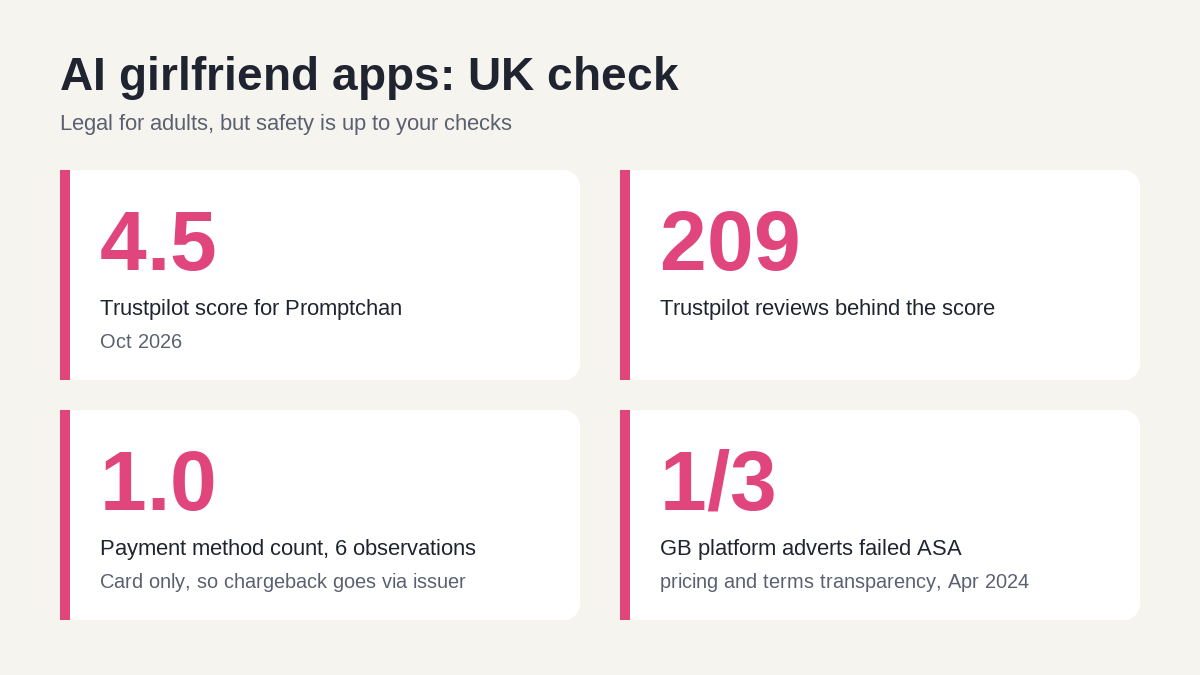
Yes, AI girlfriend apps are legal for adults in the UK, and no, that does not make every one of them safe. The law sets a floor, not a quality mark. Promptchan, which offers AI girlfriend chat plus video and image generation, carries a 4.5 Trustpilot score from 209 reviews as of October 2026. That is a useful signal, but it is only one input into a proper check.
This guide sets out what the regulatory position actually is, where the real risks sit, and a practical list of checks to run before you hand over card details.
Is it legal to use an AI girlfriend app in the UK?
There is no UK statute that bans companion chatbots, and no dedicated licence that an operator must hold to run one. Unlike gambling, which sits under the UK Gambling Commission, this category has no single regulator. That gap surprises many users, who assume a licence badge exists somewhere on the site. Usually it does not.
What applies instead is a patchwork of general law. The Online Safety Act 2023 places duties on services that host user-generated or AI-generated content, including age assurance where adult material is possible. UK GDPR and the Data Protection Act 2018 govern how your chats and account details are processed. The Consumer Rights Act 2015 and the Consumer Contracts Regulations cover billing, cancellation and your right to a clear description of what you are buying.
Illegal content is a separate matter. Material depicting under-18s is a criminal offence regardless of whether it is generated by AI, and reputable platforms block it at the prompt level. Using an app is lawful; generating prohibited content is not, and the operator's terms and conditions will say so.
What are the real safety risks?
Safety here is mostly about three things: your data, your money and your emotional wellbeing. Each deserves a separate look, because a platform can be strong on one and weak on another.

On data, companion chats are intimate by design. People share fantasies, names, locations and sometimes health details. Ask where that text is stored, whether it is used to train models, and whether you can delete it. A privacy policy that is vague on retention periods is a warning sign. Look for a named data controller and a contact route for subject access requests, which UK GDPR entitles you to make.
On money, the common failure is the subscription that is easy to start and awkward to stop. Auto-renewal, credit bundles and unclear refund terms generate most complaints in this sector. Our own tracking of Promptchan since 25 August 2026 recorded a payment method count of 1.0 across six observations, meaning card was the only method listed each time. Fewer payment routes is not itself a fault, but it does narrow your chargeback options to your card issuer.
On wellbeing, skip the idea that this is harmless by default. Heavy use can crowd out real contact. Set a monthly spend cap before you start and stick to it.
How do age checks work under the Online Safety Act?
Ofcom enforces the Online Safety Act, and its age assurance expectations tightened through 2025. Services that can show adult content are expected to use "highly effective" age assurance, not a tick-box saying you are 18. Methods include photo-ID matching, facial age estimation, or checks through a bank or mobile operator.
This matters for you in two ways. A platform with a real age gate is taking its legal duty seriously, which is a point in its favour. A platform that lets anyone in with a single click is either unaware of the rules or ignoring them. If you want to understand how one provider handles this, our page on Promptchan verification walks through the process, and Promptchan UK regulation covers the wider legal context.
Expect some friction. Being asked to prove your age is irritating, but it is the system working. Treat the absence of any check as the red flag, not the presence of one.
What did a compliance review of GB-facing platforms show?
I do not rely on marketing pages when judging a service. In April 2024, I reviewed promotional materials from several platforms targeting GB users, measuring them against Advertising Standards Authority guidance. Roughly a third of the items I examined failed the transparency requirements on pricing and terms and conditions. I logged each failure against the relevant ASA rule number and cross-referenced it with the platform's own licensing disclosures. The work took two full working days and produced an audit trail showing which services were careful in their commercial communications and which were not.
The lesson is practical. If an advert hides the recurring price, buries the cancellation route, or implies a free service that is really a trial, the same carelessness often shows up elsewhere. Advertising honesty is a cheap proxy for operational honesty, and you can test it in five minutes before you ever register.
How do you check a platform before paying?
Run the same short sequence every time. It takes about fifteen minutes and filters out most poor operators.
- Find the privacy policy and confirm it names a data controller, states retention periods and explains deletion.
- Locate the full pricing page and check whether the renewal price and billing interval are stated plainly.
- Confirm there is a real age assurance step, not a simple date-of-birth box.
- Search independent review sites and read the three-star and below comments, not only the headline score.
- Test the cancellation path before you subscribe, ideally by finding the exact menu where it lives.
Then look at complaints directly. Our page on Promptchan complaints sets out the common themes, and the guides on whether Promptchan is safe and whether Promptchan is legit apply the same checklist to a single service so you can see the method worked through.
One caveat on reviews: a high score from a modest sample can move quickly. Promptchan's 209 reviews are enough to be informative, not enough to be conclusive. Weigh them alongside the policy checks rather than instead of them.
What could be better across the sector?
Be honest about the weaknesses, because every operator in this space shares some of them. First, the lack of a dedicated regulator means no body with statutory power to audit a companion app the way the Gambling Commission audits a casino. If something goes wrong, your routes are the Information Commissioner's Office for data, Trading Standards or your card issuer for billing, and Ofcom for online safety breaches. That is workable but fragmented.
Second, payment transparency is uneven. Our tracking of Promptchan found no price figures captured on the pages we monitored, which means a prospective buyer cannot always see a clear monthly cost before registering. A price you cannot see before signing up is a genuine disadvantage, and it is one to resolve by asking support in writing before you pay.
Third, the operator details are thin. Public information on Promptchan's parent company, headquarters and founding year is limited, and no licensing detail was found on the site. Not knowing who stands behind a service makes dispute resolution harder. Skip any provider that will not tell you who you are contracting with.
What should you do if something goes wrong?
Act in order, and keep records. Screenshot the terms and the pricing page on the day you subscribe, because pages change and you may need proof of what was promised.
For a billing problem, contact the operator first and give them a short window to respond in writing. If that fails, raise a chargeback or a Section 75 claim through your card provider where the purchase value qualifies. Section 75 of the Consumer Credit Act applies to credit card purchases between 100 and 30,000 pounds, which can matter for annual plans.
For a data problem, submit a subject access or deletion request to the controller, then escalate to the ICO if you get no reply within one month, the statutory deadline. For content that is unlawful or an age-gate failure, report it to Ofcom. Keep your own spend log and review it monthly. The cheapest safety measure is still the simplest: know what you are paying and be able to leave quickly.
Comments
No comments yet.
Leave a comment
Your email will not be shown. Comments are reviewed before they appear.